

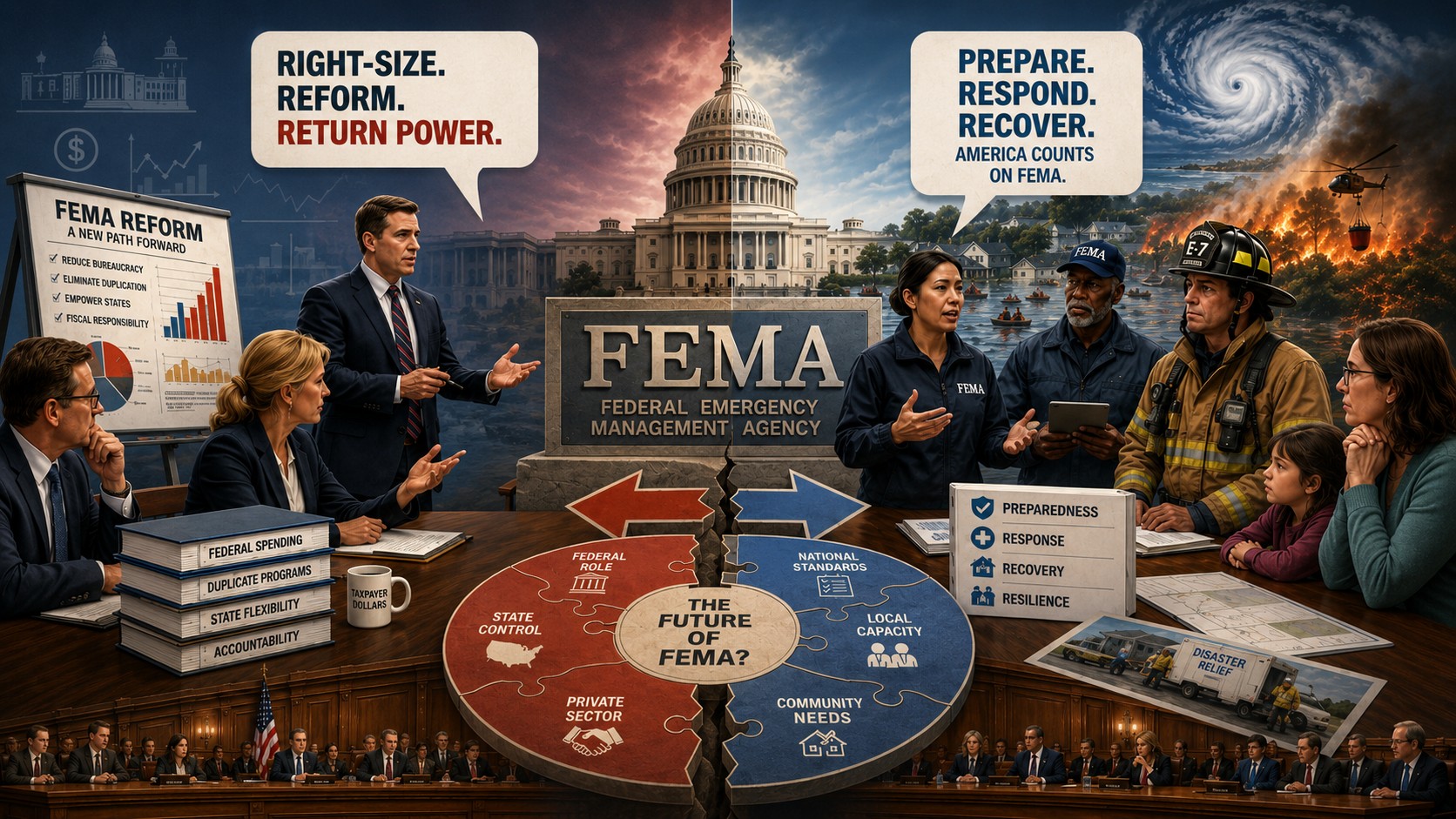
I have spent three decades inside emergency management systems built on a common doctrine. Incident Command. National coordination frameworks. Tiered response. Standardized training. Credentialed professionals. Most of that architecture, in one form or another, traces back to one source: the model the United States built and exported through FEMA.
So when I watch that model being dismantled, I do not read it as an American story.
I read it as a stress test. And the thing being tested is not just one agency. It is the question every national EM system should now be asking itself: when political pressure is strong enough, is our coordinating architecture protected or exposed?
What FEMA Actually Does—Before We Discuss Dismantling It
The public debate frames FEMA as a disaster response agency. Send in trailers. Process claims. Deploy teams after hurricanes.
That framing misses most of what FEMA is.
FEMA is the standardization engine of American emergency management. It sets the doctrine. It funds and certifies the training pipeline. It maintains NIMS, the National Incident Management System, which is the operational language that allows a county fire chief, a state emergency manager, a federal coordinator, and a private sector partner to work the same incident without a translation layer. It manages the credentialing frameworks that define what a qualified emergency manager is. It funds the Exercise Program that tests whether plans actually work.
The FEMA Review Council’s final report, approved on May 7, 2026, proposes major changes that would shift more responsibility for disaster management to state, local, tribal and territorial governments.
That sounds reasonable until you ask what fills the coordination vacuum above the state level. And who maintains the doctrine? And who funds the training? And whether fifty state systems, each going its own direction, produce national capability or national fragmentation.
The Real Diagnostic Question
There is a question at the center of this debate that almost no one is asking directly.
Is the FEMA model the problem? Or is the implementation the problem? Or is it political interference with a sound model that created the conditions we are now calling a failure?
These are not the same diagnosis. And they do not produce the same prescription.
FEMA staffing decreased 9.5 percent between January and June 2025, primarily due to the administration’s workforce reduction program, leaving the agency less prepared to deal with a major disaster. The agency was simultaneously managing more than 300,000 projects across more than 600 open disaster declarations with a smaller staff. A 76-day DHS funding shutdown ran through April 2026 while active recovery operations continued.
These are not evidence that the FEMA model is broken. They are evidence of what happens when a coordinating institution is systematically underfunded, understaffed, and subjected to leadership discontinuity over an extended period. The dysfunction that created the political case for dismantling FEMA was, in significant part, produced by the same political environment now citing that dysfunction as justification.
I have seen this pattern in other systems. Not in the US. The mechanism is consistent: underfund the institution, document the resulting failures, then use the failures to argue the institution should not exist. The model never gets a fair test because the model never gets the conditions it requires to function.
The Coordination Function Cannot Be Devolved
The Review Council recommends transforming FEMA into a leaner agency with a reduced headquarters footprint and a formal role as ‘payer of last resort,’ meaning other federal programs must be exhausted before FEMA steps in.
There is a legitimate argument for reducing federal operational footprint in routine disasters. Subsidiarity is a sound principle. Local actors know their terrain. State governments should carry primary response responsibility.
But subsidiarity and coordination are not the same function. You can devolve operations. You cannot devolve standards.
If FEMA no longer sets the doctrine, who does? If FEMA no longer funds the national exercise program, who validates whether state and local systems actually work? If the credentialing framework fragments across fifty state systems, what does ‘qualified emergency manager’ mean when a multi-state disaster requires integrated command?
Significant questions remain about whether many jurisdictions possess the staffing, funding, and operational resources to absorb the responsibilities being shifted to them.
That gap does not close by reducing the federal coordinating function. It widens.
What the World Is Watching
This is where the conversation must leave US borders.
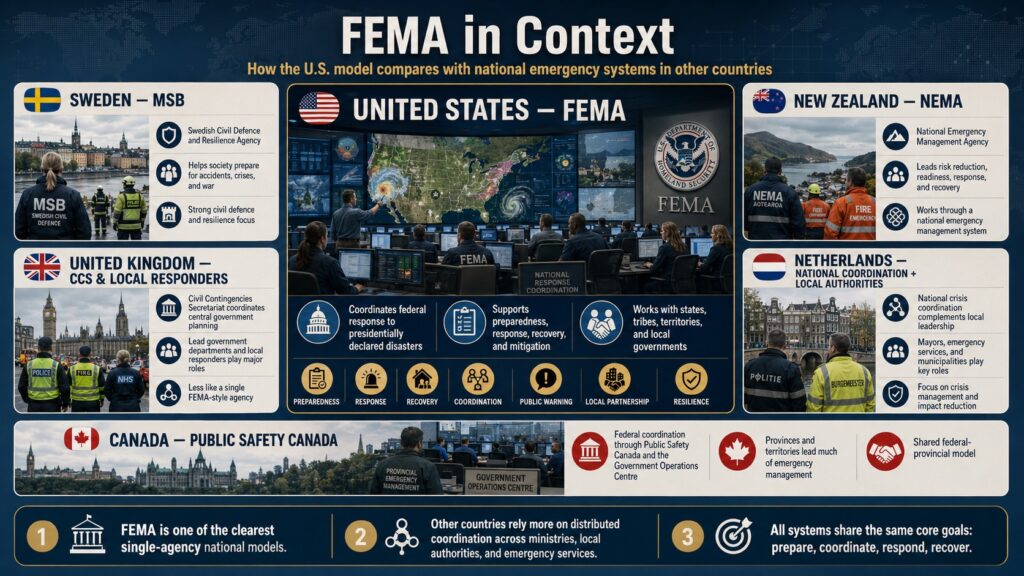
ICS, NIMS, the Incident Command System in its various national adaptations, the whole architecture of professional emergency management that has been adopted, adapted, and institutionalized across the GCC, Southeast Asia, Europe, and beyond, has FEMA’s model somewhere in its lineage.
Countries that are building national emergency management capacity right now are watching this moment. They are watching whether the country that originated the model can protect its own coordinating institution from political interference. And they are drawing conclusions.
If the answer is that even in the originating country, a national EM coordinating body can be systematically weakened through budget cuts, leadership instability, and political pressure, and then dismantled when the resulting dysfunction becomes visible, that is a signal. It tells every government with an appetite for reducing its own emergency management investment that the model itself is optional. That coordination is a cost, not a capability. That standards are bureaucracy, not infrastructure.
That is the message being sent whether it is intended or not.
A Question the Profession Needs to Answer
I am not arguing that FEMA has no problems. Every institution built over fifty years in a changing risk environment has problems. Reform is legitimate. The question of federal versus local responsibility is worth serious debate.
But there is a difference between reforming a coordinating institution and dismantling its coordinating function. One strengthens the model. The other leaves the field without a standards architecture and calls it decentralization.
The question I would put to every emergency management professional reading this, regardless of where you practice:
If political pressure in your country produced the same conditions FEMA faced, a 9 percent workforce cut in six months, a 76-day funding freeze during active operations, three leadership changes in eighteen months, would your national coordinating body survive with its doctrine function intact? Or would we be having the same conversation about your system in five years?
The model is not the problem. That answer matters more than most people in this profession are saying out loud.
References
1. FEMA Review Council — Final Report, May 7, 2026. FEMA.gov
2. National League of Cities — FEMA Review Council Final Report Signals Major Shift in Federal Disaster Policy, May 2026
3. Bipartisan Policy Center — FEMA Reform: Comparing the Review Council’s Recommendations and Congressional Proposals, May 2026
4. National Association of Counties — FEMA Review Council Releases Final Report Recommending Sweeping Changes, May 2026
5. Center on Budget and Policy Priorities — Trump Administration Actions Weakening Disaster Preparation and Response, November 2025